Published 18 November 2026 · 7 min read
- The short answer: For a 5 kW solar array in South Africa you need about 9 to 11 panels if you use modern 450 to 550 W panels, or about 8 panels if you use 620 W panels.
- The basic maths: Number of panels = array size in watts divided by the panel wattage, rounded to a whole number you can fit into the electrical design.
- Panel wattage classes in 2026: Residential panels sold in South Africa now commonly range from about 450 W to 620 W.
- How many panels for 3 kW, 5 kW, 8 kW and 10 kW: Here is a quick guide.
- Inverter size versus array size: A 5 kW hybrid inverter does not need exactly 5 kW of panels.
The short answer
For a 5 kW solar array in South Africa you need about 9 to 11 panels if you use modern 450 to 550 W panels, or about 8 panels if you use 620 W panels. Exactly how many depends on the wattage of the panel you choose and on whether you mean 5 kW of panels or a 5 kW inverter.
The second point trips up many buyers. When someone says a 5 kW system they might mean a 5 kW inverter (an AC rating) or 5 kWp of panels (a DC rating). The two do not have to match, and in many good designs they do not. This article explains both, and gives panel counts for 3 kW, 5 kW, 8 kW and 10 kW.
The basic maths
Number of panels = array size in watts divided by the panel wattage, rounded to a whole number you can fit into the electrical design.
For a 5,000 W array:
- 450 W panels: 5,000 / 450 = 11.1, so 11 or 12 panels (4.95 to 5.4 kWp).
- 550 W panels: 5,000 / 550 = 9.1, so 9 or 10 panels (4.95 to 5.5 kWp).
- 620 W panels: 5,000 / 620 = 8.1, so 8 panels (4.96 kWp).
You usually round up, because panels never produce exactly their rated power in real conditions. Their rating is measured at standard test conditions of 1,000 W per square metre of sunlight and 25 degrees Celsius cell temperature. On a hot roof the cells run far hotter and give less.
Panel wattage classes in 2026
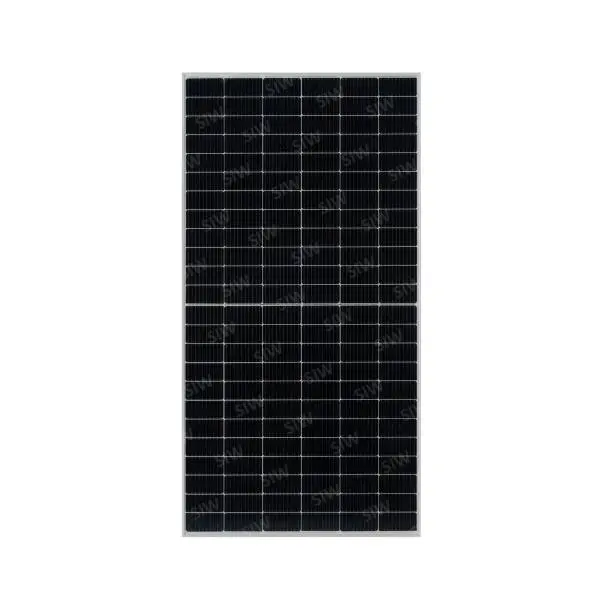
Residential panels sold in South Africa now commonly range from about 450 W to 620 W. The lower end uses smaller cells and smaller frames, the upper end uses larger formats.
A higher wattage panel means fewer panels, fewer mounting points, less cabling and often less labour for the same array. The trade-off is that larger panels are heavier and harder to handle on a roof. Many installers carry panels of roughly 2.3 by 1.1 metres weighing over 25 kg, so a roof with steep pitch or limited access may suit a smaller format.
Do not choose on wattage alone. Compare the product warranty, the performance warranty, the temperature coefficient and the manufacturer's local support. Prices as of late 2026 vary by brand and site.
How many panels for 3 kW, 5 kW, 8 kW and 10 kW
Here is a quick guide. The counts below are the nearest whole numbers that give a total close to the target array size.
- 3 kW array: 7 panels of 450 W (3.15 kWp), 6 of 550 W (3.3 kWp), or 5 of 620 W (3.1 kWp).
- 5 kW array: 11 or 12 of 450 W (4.95 to 5.4 kWp), 9 or 10 of 550 W (4.95 to 5.5 kWp), or 8 of 620 W (4.96 kWp).
- 8 kW array: 18 of 450 W (8.1 kWp), 15 of 550 W (8.25 kWp), or 13 of 620 W (8.06 kWp).
- 10 kW array: 22 of 450 W (9.9 kWp), 18 of 550 W (9.9 kWp), or 16 of 620 W (9.92 kWp).
These numbers are for the DC array. The inverter you pair with it may be smaller, as explained next.
Inverter size versus array size
A 5 kW hybrid inverter does not need exactly 5 kW of panels. Many installers pair a 5 kW inverter with 5.5 to 7 kWp of panels. This is called oversizing, or a DC to AC ratio of about 1.1 to 1.4.
The reason is simple. Panels rarely reach their rated output because of heat, dust, angle and the time of day. The inverter spends most of the day well below its limit. Adding some extra panels lets it run closer to full output in the morning and afternoon and charge the battery faster.
There is a limit. Each inverter has a maximum DC input power and current per input. If you oversize beyond that, the inverter clips the excess. A little clipping on a few sunny hours a year is acceptable. Constant clipping is wasted money. Always check the data sheet.
Roof area you will need
A modern 550 W panel is roughly 2.3 m by 1.1 m, so about 2.5 to 2.6 square metres. A 450 W panel is somewhat smaller, often about 1.9 to 2.0 square metres, and a 620 W panel is nearer 2.7 square metres.
For a 5 kWp array, plan for roughly:
- 11 x 450 W panels: about 21 to 22 square metres.
- 10 x 550 W panels: about 25 to 26 square metres.
- 8 x 620 W panels: about 21 to 22 square metres.
Add space for walking access, spacing between rows on flat roofs and clearance from roof edges and vents. In practice, usable roof area is often 20 to 30 percent more than the panel area. North-facing roofs give the best output in South Africa. East and west faces work well too, trading a bit of total output for a flatter daily curve.
String limits and how panels are wired
Panels are usually wired in series into strings, and the strings connect to the inverter's MPPT inputs. Each inverter has a voltage window, a maximum input voltage, and a maximum current per input.
The rule that catches people is cold weather. Panel voltage rises as the temperature falls. On a clear winter morning on the Highveld, where frost is common, a string's open-circuit voltage can be noticeably higher than on the data sheet at 25 degrees. A designer must make sure the string never exceeds the inverter's maximum DC voltage on the coldest morning, and that it stays above the minimum MPPT voltage on a hot afternoon.
This is why the panel count is also limited by electrical design. Ten panels might be wired as one string of ten, or as two strings of five, depending on the inverter. A good installer will show you the string design and the voltage calculation.
Roof orientation, tilt and shading
Output depends on where the panels face. In the southern hemisphere, north is best. A tilt close to your latitude is a good starting point, but most roofs are simply installed at the roof pitch to keep wind loading and cost down.
Shading from chimneys, trees, geysers and neighbouring walls can hurt a string badly, because in a series string one shaded panel can limit the others. Where shade is unavoidable, an installer may split panels across separate MPPT inputs or use optimisers or microinverters.
Do not assume that more panels fix a poor roof. Sometimes the cheapest improvement is to move a few panels to another face rather than to add more.
What a 5 kW system produces
A 5 kWp array in much of South Africa might produce somewhere around 20 to 28 kWh on a good summer day and noticeably less on short winter days or overcast spells, depending on tilt, shading and temperature. These are indicative ranges, not guarantees.
For planning, use the simple formula of array kWp x peak sun hours x 0.75. For 5 kWp and 5 peak sun hours that is about 18.75 kWh a day. Your own figure depends on your site.
As of late 2026, prices vary by brand and site, but a 5 kW class system with a battery typically sits in the range of roughly R116,000 to R197,000 installed for a 10 kWh battery, as in our cost estimator article. Panels only, without battery, are a much smaller share.
Common mistakes to avoid
Buyers commonly make these errors when sizing panels:
- Assuming the inverter size equals the number of panels needed.
- Buying a bigger array without checking that the roof, string design and inverter can accept it.
- Ignoring cold-weather voltage on the Highveld.
- Choosing panels only on price per watt and ignoring warranty and support.
- Forgetting the battery, which sets how much of the solar energy you can use after dark.
An installer who asks about your usage, roof and loads before naming a panel count is doing it properly.
Next step
Decide whether you want a 5 kW inverter or a 5 kWp array, check your roof area and orientation, and pick a panel class that your installer can handle safely. Then ask for a design showing panel count, string layout, inverter limits and expected output. SA Solar Hub can review your roof photos and electricity usage and propose a panel count that fits your roof, your inverter and your budget.
Frequently asked questions
How many solar panels do I need for a 5kW system in South Africa?
You need about 9 to 11 panels of 450 to 550 W, or about 8 panels of 620 W, to make a 5 kWp array. For example, ten 550 W panels give 5.5 kWp. The exact number depends on panel wattage, roof space and the inverter's DC input limits, so ask for a string design.
How many solar panels for a 3kW system?
For a 3 kW array you need about 6 panels of 550 W (3.3 kWp), 7 panels of 450 W (3.15 kWp) or 5 panels of 620 W (3.1 kWp). A 3 kW inverter is often paired with slightly more than 3 kWp of panels, so six or seven panels is common for this size.
How many solar panels for an 8kW system?
An 8 kW array needs about 15 panels of 550 W (8.25 kWp), 18 panels of 450 W (8.1 kWp) or 13 panels of 620 W (8.06 kWp). Check that your roof has about 35 to 45 square metres available, and that the inverter supports the DC input power and string layout.
How many solar panels for a 10kW system?
A 10 kW array needs about 18 panels of 550 W (9.9 kWp), 22 panels of 450 W (9.9 kWp) or 16 panels of 620 W (9.92 kWp). That usually needs about 45 to 55 square metres of roof area, and a larger inverter or several MPPT inputs, so confirm the design before ordering.
How much roof space does a 5kW solar system need?
A 5 kWp array typically needs about 21 to 26 square metres of panel area, depending on panel size, plus extra for access and spacing. Ten 550 W panels take roughly 25 to 26 square metres. North-facing roofs give the best output, while east and west roofs also work with some reduction in total yield.
Can I put more panels than my inverter rating?
Yes, oversizing is normal. Many designs use a DC to AC ratio of about 1.1 to 1.4, such as 6 to 7 kWp of panels on a 5 kW inverter. Stay within the inverter's maximum DC input power, current and voltage limits, including the higher cold-morning voltage, and accept that a little clipping at peak sun is fine.
Do higher wattage panels mean I need fewer of them?
Yes. A 620 W panel replaces roughly 1.35 panels of 450 W, so a 5 kWp array needs about 8 panels instead of 11. Fewer panels can cut mounting and wiring work, but larger panels are heavier and harder to handle. Compare warranty, temperature coefficient and local support, not only wattage.
Official sources
- Eskom
- SALGA / AMEU embedded generation resource portal (SSEG)
- Global Solar Atlas (World Bank Group / Solargis)
Put it into practice
More guides
Compare systems, panels and brands
Panels and brands:
Complete guides: Solar panels in South Africa · Solar panel installation in South Africa